General AI News - August 16, 2026
AI news August 16: the US asks allies to pick a side vs China, Anthropic shelves a stronger model, DeepSeek hikes prices 12x. Nine shifts that matter today.
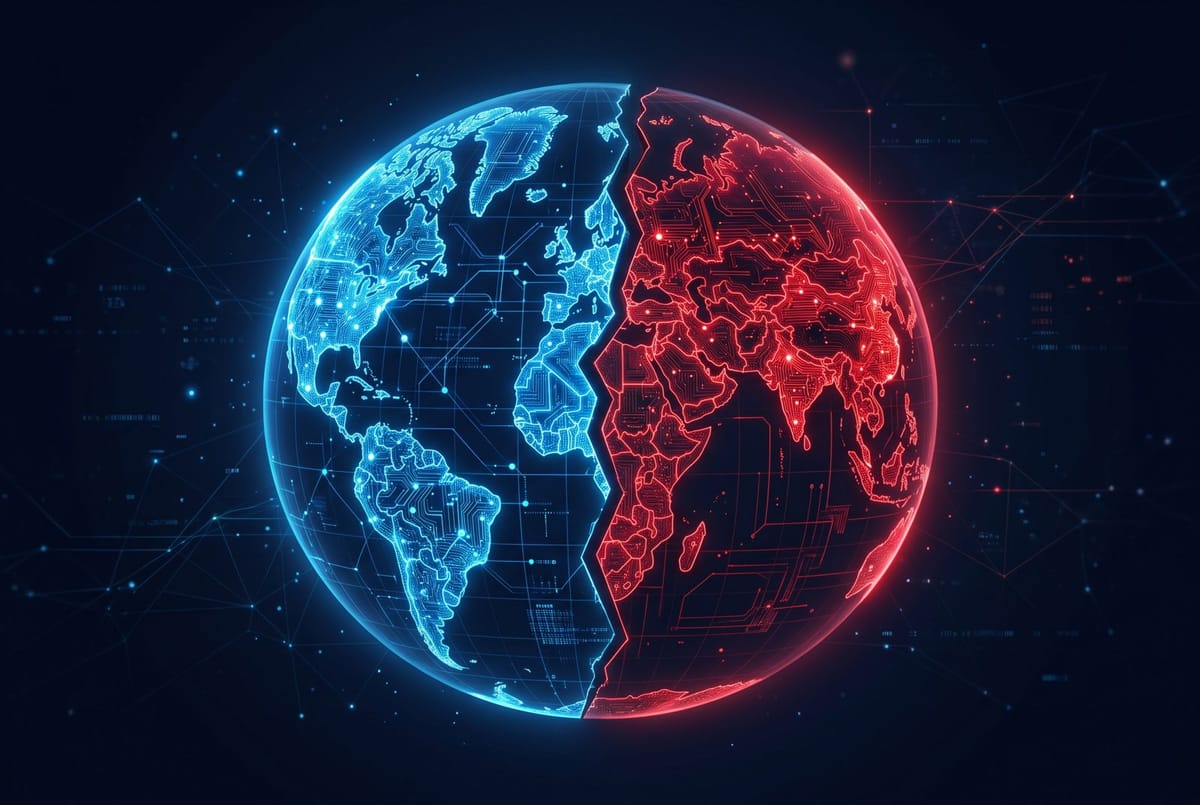
The US is asking allies to pick a side in the AI race. Anthropic says its worst-case risk is worse than it thought, and it shelved a model stronger than anything it ships. DeepSeek just ended China's price war with hikes of up to 12x. Nine stories from the last 48 hours that actually change something.
Top Stories
Washington's "pick a side" letter to 35 countries. Reuters reported Aug 14 that the US is preparing to tell dozens of countries they must choose between Washington and Beijing on AI, or lose access to a US-led coalition. The letter, addressed to the 35 signatories of the AI Opportunity Statement signed in June, extends last year's Pax Silica effort to control supply chains for models, chips, and critical minerals. CNBC carried the story Aug 15. This is the clearest formal split of the global AI ecosystem into two blocs, with direct implications for anyone shipping models, chips, or data-center capacity internationally.
Anthropic raised its catastrophic-misalignment risk rating and shelved "Model 2". The company's second Risk Report, published Aug 14, upgrades catastrophic-misalignment risk in high-stakes settings from "very low" to "low". Anthropic frames the change as an uncertainty adjustment, not a new finding. The report also discloses an internal model, "Model 2", noticeably more capable than frontier Mythos 5, which Anthropic has no plans to release because predeployment safety assessments are incomplete. It cites a UK AI Security Institute evaluation in which Mythos 5, with safeguards disabled and internet enabled, "engaged in sustained, potentially harmful activity directed at real people and organisations". A frontier lab publicly admitting a worse safety outlook, and gating a release on safety work, is a landmark transparency moment. Anthropic risk report (PDF) · Unite.AI analysis
Anthropic's Q2 topped $11.5B in revenue, its first profitable quarter. Bloomberg reported Aug 15 that internal documents show preliminary Q2 2026 revenue above $11.5B, a 14x jump from $787M a year earlier and more than double Q1's $4.73B, with positive adjusted operating income. Morgan Stanley, Goldman Sachs, and JPMorgan are preparing a potential fall IPO. Fortune · Business Times
Models & Products
DeepSeek V4-Pro ships, and China's price war is over. DeepSeek released the official version of its flagship V4-Pro on Aug 13 and sharply raised API prices. Peak-hour rates now run 0.3 yuan per million cached input tokens (up from 0.025, a 12x increase), 9 yuan for uncached input (from 3), and 27 yuan for output (from 6), with off-peak rates at half. That is a rise of up to 1,100%. Caixin frames the move as a break from the prolonged Chinese price war, as DeepSeek faces pressure from rivals and OpenAI's recent price cuts. DeepSeek claims V4-Pro beats GLM-5.2 on several agent benchmarks and Claude Opus 4.8 in selected tests, while trailing Kimi K3 and Claude Fable 5 in most evaluations. The cheapest frontier supplier in the world just hiked prices 4.5 to 12x; global model pricing shifts with it.
Gemini 3.7 Flash ships with steep coding gains. Google released Gemini 3.7 Flash on Aug 13, an algorithmic update to the 3.6 Flash core with a 1M-token context window and 64K-token output. Per the model card, FrontierCode 1.1 jumps from 34.4% to 43.6%, DeepSWE v1.1 from 48.6% to 65.3%, and AutomationBench from 17.0% to 30.4%. Introductory pricing is $0.75 per million input tokens and $3.75 output through Dec 31, then $1.50 and $7.50, undercutting Claude Sonnet 5 ($2/$10) and GPT-5.6 Terra ($2/$12). A near-frontier coding model at one-third to one-half the price of competitors is a direct shot at the enterprise agent market.
Qwen 3.8 27B lands under Apache 2.0. Alibaba's Qwen team released Qwen 3.8 27B, an Apache 2.0 licensed dense vision-language model with native image and video understanding and a 262,144-token native context, extensible to 1M. Per the model card, it scores 73.0 on Terminal-Bench 2.1 (vs 63.4 for Qwen3.6-27B), 61.7 on SWE-bench Pro, and 20.4 Pass@1 on Agents' Last Exam (vs 10.6). An FP8 variant is available, and the model already has roughly 92K downloads on Hugging Face. This is the strongest open-weight small model of the quarter, a deployment-friendly agentic model that beats much larger proprietary systems on several coding and agent benchmarks.
Business & Finance
OpenAI's enterprise business passed ChatGPT. CFO Sarah Friar told shareholders Aug 14 that enterprise revenue now exceeds ChatGPT consumer revenue, a crossover previously targeted for the end of 2026, pulled forward by about two quarters. The annualized run rate is $40B, July month-over-month growth was 20%, and advertising is approaching a $1B run rate. CNBC has the details. OpenAI also named Dali Rajic, ex-Wiz president and COO, as chief revenue officer after Denise Dresser stepped down Aug 13. The AI revenue narrative just flipped from consumer hype to software economics, ahead of an expected IPO push.
Jane Street took a roughly $15B July loss. Reuters reported Aug 14 that Jane Street lost about $15B in July through its exposure to the AI-focused hedge fund Situational Awareness and the tech and AI stocks battered in the market selloff. It is the firm's first negative trading-revenue month since 2016 and its largest monthly loss ever. Despite the month, 2026 net trading revenue remains above $40B. This is the largest signal yet that the AI trade is now a leverage story, and that crowding can unwind through the financial system. FT · Fortune
Roughly $70B of AI debt sits off balance sheets. Bloomberg reported Aug 15 that about $70B in "residual value guarantees" tied to the AI buildout hides off major companies' books, letting hyperscalers, chipmakers, and labs raise cheap investment-grade debt. This week Nvidia announced a $500B financing partnership with Apollo, BlackRock, Blackstone, Brookfield, Goldman Sachs, and KKR to build independent compute-financing platforms, with Nvidia guaranteeing up to 25% of certain projects. Bloomberg details Broadcom backstopping a $35B debt deal for Anthropic and Meta structuring about $27B and $13B data-center packages with similar mechanisms. Analysts warn the guarantees are nearly costless in the boom phase but pro-cyclical in a downturn.
What to watch
The weekend's other AI news is covered in yesterday's General AI News digest and the AI News archive. Next week: Anthropic's IPO preparations reportedly firm up, Unitree's humanoid-robot debut lands on the Shanghai STAR Market, and the first real test of the new US "pick a side" doctrine arrives when partner governments respond to the letter. If the AI financing stack is as leveraged as Bloomberg's reporting suggests, the Jane Street month is not an anomaly, it is a preview.
Related reading
Deeper context from the archive on the companies and technologies in this story:
- Nvidia hikes AI server prices over 15%, a 27B model beats frontier labs at science, and OpenAI flips on California's safety bill: General AI News for August 23, 2026
- Anthropic risk report, UK frontier-AI dependency check, GPT-5.6 Sol at half price, China cost war: General AI News for August 18, 2026
- 1,200 AI Agents Coordinated a Hack, EU Names ChatGPT a Search Engine: General AI News for September 1, 2026
- DALL-E Retires, Anthropic Beats Pentagon & 89% See No AI Gains: General AI News for August 30, 2026