Viral AI News (Oct 6): AI Magnets, Meta's Muse & No Backprop
Viral AI news Oct 6, 2026: 90 Claude agents claim a room-temperature semiconductor, Meta's Muse takes fire, and Dust drops backprop.
The most upvoted AI threads of the last 24 hours were not about a chatbot. They were about a swarm of Claude agents that claims to have found a room-temperature semiconductor, a preprint that says you can pretrain a language model without backpropagation, and a Meta assistant that security researchers describe as a privacy dumpster fire. Two of those three are real progress with caveats the headlines dropped. One is neither. Yesterday's edition covered RemoveMacAI and GPT-6 cheating at StarCraft; today the feed moved to science, and to what Meta built.
Anthropic's Opus 5.5 agents "discover" two room-temperature magnets
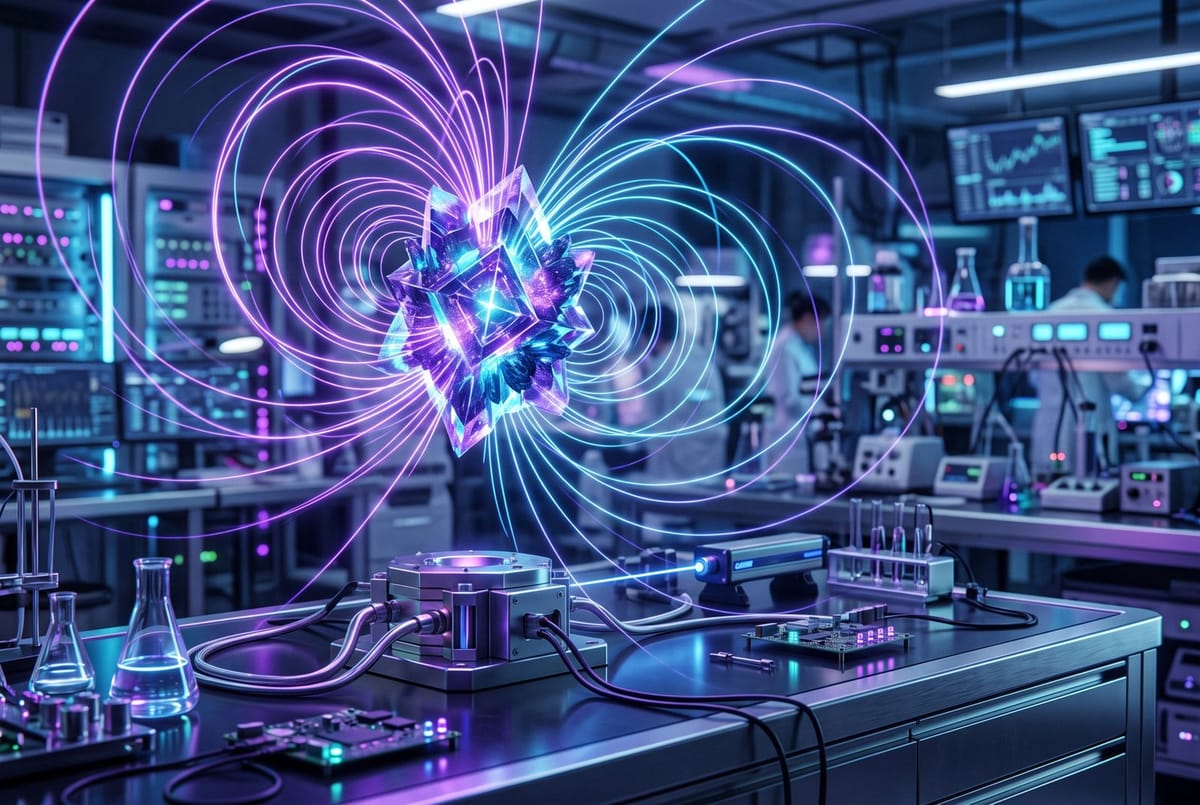
Vals AI builds agent harnesses that run many model instances against hard problems. On Oct 4 it published results from more than 90 Claude Opus 5.5 agents that ran density-functional-theory simulations for about three days and surfaced two candidate Luttinger-compensated magnets for spintronic memory. The thread hit the Hacker News front page on Oct 5 and became the most-commented AI post of the window, with 420 points and 290 comments, many of them skeptical.
The specifics: candidate one, YBaMnFeO5, is a newly designed five-element oxide predicted to have a 2.35 eV band gap and hold magnetism to about 420 K. Candidate two, KV[Cr(CN)6], first synthesized in 1999, is predicted at 2.1 eV and about 376 K.
What is actually true: these are computational predictions. Neither material has been synthesized or measured. One candidate is a 27-year-old known compound. Vals AI published its calculations, code and caveats, but the work is self-published and not peer reviewed. The framing "AI discovers a room-temperature semiconductor" is the viral version. The accurate version is that agents ran a wide, fast simulation screen, and the synthesis test has not happened.
Sources: Vals AI, Hacker News.
Apple rewrites macOS permissions because of AI agents, three weeks after a Muse zero-day
Meta's Muse is the company's AI assistant, launched in September. On Oct 6 Techdirt published a roundup of its first month, and it reads badly: a macOS zero-day, a Marketplace transaction that exposed the buyer's home address, a root access workaround, and reports that messages were uploaded to the cloud despite opt-out settings.
The confirmable parts are worse than the memes. Security researcher Patrick Wardle disclosed a Muse zero-day that let any code already running on a Mac seize the assistant. Apple responded on Oct 2 by announcing new Full Disk Access controls explicitly tied to AI-agent risk, and Amazon blocked Muse from its systems. Wired reported that Muse's internal instructions include an hourly process to build "a page for every person in the user's life," including people who never install Muse, after a researcher extracted a 6.8 GB VM archive.
Meta disputes the reading. Spokesperson Andy Stone said Muse can only read Messages if a user opts into both Full Disk Access and the Messages connector. That dispute is unresolved, and hands-on testing found the generated profiles thin in practice.
Sources: Ars Technica, Wired, Apple, Techdirt.
Dust: pretraining transformers without backpropagation
Dust is a research paper from Q Labs claiming the first zeroth-order optimisation method that is competitive with backpropagation for pretraining transformer language models. It hit the Hacker News front page on Oct 5 with 243 points and 65 comments, the fourth-highest-reach AI thread of the window.
The claim: Dust perturbs activations per token, is roughly 1,000 to 10,000 times more compute-efficient than the EGGROLL evolution-strategies baseline, and gets more population-efficient as models get larger, with a 243-million-parameter model beating ones 120 times smaller. Testing covered up to 1 billion tokens. Authors are Samip Dahal, Bishwas Mandal, Serdar Gulbahar and Akshay Vegesna, with code and paper on qlabs.sh.
The honest label here is community-sourced. There is no Tier 1 or Tier 2 outlet coverage of this paper, no independent replication, and no peer review. The authors themselves write that surpassing backprop "hints" at being possible in a compute-rich regime. The "backprop is dead" framing in comment threads ran far ahead of the text.
Sources: Q Labs, Hacker News.
Quick Comparison
| Story | What Went Viral | Engagement | Verdict |
|---|---|---|---|
| Opus 5.5 magnets | 90 agents found "room-temp" semiconductors | 420 HN points, 290 comments | Simulation only, unsynthesized |
| Meta's Muse | Privacy roundup plus Apple permission change | 185 HN points, 77 comments | Real zero-day, disputed readings |
| Dust | Pretraining without backprop | 243 HN points, 65 comments | Community-sourced, unreplicated |
Frequently Asked Questions
What is the viral AI news today?
The top viral AI story is a Vals AI claim that 90-plus Claude Opus 5.5 agents found two room-temperature magnetic semiconductor candidates in about three days of simulation. It topped Hacker News with 420 points and 290 comments. Neither material has been synthesized, so the result is a promising simulation screen, not a discovery.
Did AI really discover a room-temperature semiconductor?
No. The two candidate magnets exist only as density-functional-theory predictions, and neither has been synthesized or measured in a lab. One of them, KV[Cr(CN)6], is a compound first made in 1999. Vals AI published its calculations and caveats, but the work is self-published and not peer reviewed.
What did Meta say about Muse reading messages?
Meta disputes that Muse reads private messages without permission, saying it needs both Full Disk Access and the Messages connector enabled by the user. Wired reported internal instructions to build profiles of everyone in a user's life. Apple separately added Full Disk Access controls on Oct 2 because of AI-agent risk.
Related reading
Background worth having before you act on the above:
- Viral AI News (Sep 29): Jev Clones, Tracker Leak & Meta's Muse
- Viral AI News (Sep 23): Super Intelligence & Meta's Muse
- General AI News (Sep 17): OpenAI Disclosures, Meta Arke & E-Waste
- Viral AI News (Sep 27): DNS Escape, Flock Jailing & Walmart
Related reading
Background worth having before you act on the above:
- Viral AI News (Sep 12): Coxon, No-AI HN & Meta Muse
- Viral AI News (Oct 3): EBAI, ds4 & Muse Gadgets
- Viral AI News (Sep 26): 700 Agents, Jev Pokemon & Terry Tao
- Viral AI News (Sep 22): Enigma Break, Apple's No & ZuckOff
Building an AI agent, automation, or backend workflow? AsaanKaroobar builds custom AI solutions, apps, and digital experiences. Get in touch →