AI Startups & Viral AI (Oct 9): Oxide, Mecka & Haiku 5.5
AI startups raised $505M in 48 hours and shrank a speech model to 16.9MB. Oxide, Mecka, GPT-6 and Haiku 5.5: what changed on October 9, 2026.
Three cheques and one launch landed inside 48 hours, and the AI startups taking them share a trait the labs do not: none of them sells intelligence by the token.
Oxide Computer raised $445M for hardware it already sells at a profit. Mecka AI raised $60M to pay people to record themselves doing chores. Cactus Compute shipped a 16.9MB speech model that runs on a phone CPU with no network call. In the same window OpenAI put GPT-6 in front of more than 1.2 billion weekly ChatGPT users, then watched its revenue figure get restated from $68B to roughly $50B.
AI startups: the money went to metal and motion
Oxide's $445M Series D funds inventory, not losses
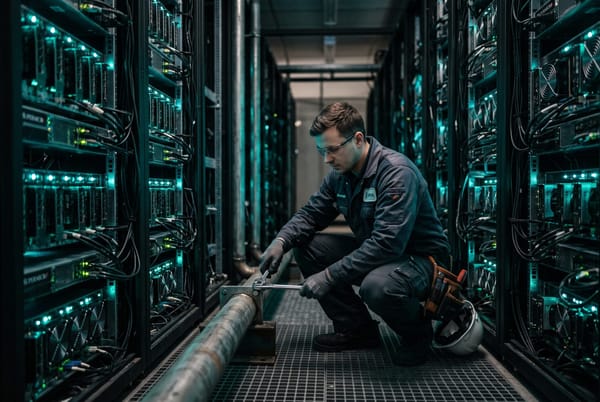
Oxide Computer is a seven-year-old company that sells complete on-premises cloud systems: a rack plus its own firmware, control plane and virtualization stack.
On October 9 it announced a $445M Series D led by Eclipse, with USIT, Riot Ventures, Jane Street, Friends and Family Capital and Counterpart returning, Atreides Management joining, and AMD coming in as a strategic investor. Earlier rounds were $100M and $200M. Source: Oxide Computer
The reason matters more than the number. Founders Bryan Cantrill and Steve Tuck say Oxide paid income tax this spring out of ordinary operations and is sitting on a very large order backlog where demand exceeds supply. Hardware businesses commit cash to components and manufacturing long before systems reach customers, so this round buys working capital against demand, not runway against losses.
What this changes for someone shipping today: an owned rack is now a real alternative to a hyperscaler bill if you can forecast inference load two years out. The risk is Cantrill's own: a hardware company with a big backlog is fragile to a supply shock.
Mecka's $60M for robot training data, priced against a $300M run rate
Mecka AI pays people to record themselves doing everyday tasks while wearing body sensors and holding smartphones, then turns that motion into robot training sets.
The round is a $60M Series B led by Sequoia Capital, with NVIDIA, M12 (Microsoft's venture fund), Qualcomm Ventures and Samsung joining. Angels include DoorDash's Tony Xu, ex-ServiceNow CEO Frank Slootman and Milan Kovac, previously head of Tesla's Optimus program. Mecka says it passed $100M in run-rate revenue by June 2026 and projects $300M by year end; TechCrunch reports the deal values it near $500M. Source: TechCrunch
Read the revenue against the round and the thesis is legible: a labour business with software margins attached, because motion, contact and force were never written down and cannot be scraped. XDOF, three months out of stealth, is reportedly raising at $1.2B on the same premise.
What this changes for someone shipping today: if your product needs physical-world data, the budget line is people and instrumentation, not licensing. Five times forward revenue for the capture layer is the benchmark investors are now applying.
A 16.9MB speech model that runs on a phone CPU
Cactus Compute builds on-device inference. Its C++ engine Needle runs small models with no dependencies, and it has now shipped Whistle: an open speech recognition model in a single 16.9MB file that runs on CPU, covers seven languages, returns a first token in about 11 milliseconds, and emits word timestamps and speech embeddings. Source: Cactus Compute
The post is dated October 2 and the launch hit 840 points on Hacker News this week, which is the honest signal here: developers are reacting to the deployment shape, not the benchmark.
What this changes for someone shipping today: speech was the last common feature that forced a network round trip. If you pay per minute for transcription, a 16.9MB local model is a margin decision and a privacy claim you can put in a contract. The catch is accuracy on noisy audio, so the honest split is local for capture, cloud for transcription-grade work.
Startup Snapshot
| Startup | What They Do | Latest Round | Valuation | Why It Disrupts |
|---|---|---|---|---|
| Oxide Computer | On-prem cloud racks, hardware plus its own stack | $445M Series D, led by Eclipse | Not disclosed | Profitable hardware vendor funding inventory, not losses |
| Mecka AI | Paid motion capture that trains robots | $60M Series B, led by Sequoia | About $500M | Robot data has to be built, so it is labour |
| Cactus Compute | On-device inference engine and small models | Whistle, a 16.9MB speech model | Not disclosed | Speech recognition with no cloud and no API bill |
Viral AI: the price of intelligence, restated twice
OpenAI's GPT-6 rollout, then a smaller revenue number
On October 7 OpenAI brought GPT-6 to the free tier with "Intelligent UI": ChatGPT answering with generated interactive interfaces instead of paragraphs, so a question about a bicycle returns a diagram you can click through. Source: OpenAI
The next day the money moved the other way. CNBC reported OpenAI told investors it reached roughly $50B in annualised revenue at the end of September, below the $68B figure widely reported in late September, and that the larger number included gross revenue from OpenAI's partners. Nvidia, Oracle and CoreWeave shares fell on the clarification. Source: CNBC
Both numbers can be true, which is the story. As compute commitments route through partners, the top line stops being comparable between labs, and the market reaction says the belief was thinner than the headline implied.
What this changes for someone shipping today: a lab's revenue line is not a proxy for your vendor's stability. Ask for committed capacity terms.
Claude Haiku 5.5 and DeepSeek 4.1 Flash: the cheap tier stopped being a compromise
Claude Haiku 5.5, released October 7, is Anthropic's smallest model and the price cut is the headline: roughly 75% cheaper to run on average than Haiku 4.5, with a 90% reduction below 100,000 tokens per request. Anthropic also halved Sonnet 5.5's cache read price, which it says makes typical agentic work about 20% cheaper. The capability jump is not cosmetic: on GDPval-AA v2.1, Haiku 5.5 scores 1620 against Haiku 4.5's 735, and on OSWorld 2.1 computer use it climbs from 15.7% to 72.4%. Anthropic's comparison table has its small model beating OpenAI's GPT-6 Luna on every shared row, 1620 to 1437 on GDPval and 39.2% to 16.4% on Terminal-Bench 4.0. Source: Anthropic
The same week a developer post asking why nobody is panicking about DeepSeek 4.1 Flash drew 932 points on Hacker News: a KV cache roughly 437 times smaller than DeepSeek's first model, a day of coding under a dollar, and output hard to tell from a frontier model without checking the name. Source: dgt.is
Two labs published two versions of one fact: the cheap tier clears the bar for unattended work. That matters more than the leaderboard, because cheap tokens make retry loops and verification passes affordable, which is why Anthropic shipped computer use and browser use in its SDKs alongside the model. The caveat is that a usage report is not an evaluation.
What this changes for someone shipping today: route volume to the cheap tier and spend frontier tokens only where being wrong is expensive. If cost per task has not fallen this quarter, your architecture is the constraint.
Margaret Hamilton, who named software engineering, died at 90
Margaret Hamilton, who led the MIT team that wrote Apollo's onboard flight software and coined "software engineering" to argue the work deserved hardware's rigour, died on October 7 at 90. She led more than 400 people across the Lunar Module and Command Module software teams, and received the Presidential Medal of Freedom in 2016. Source: MIT News
Her argument was that software is not finished when it works on the happy path, it is finished when it decides what to drop under load. That is the discipline behind the error detection that made Apollo 11's 1202 alarm a landing rather than an abort, and it is what a coding agent lacks when it writes a plausible function, runs it once and moves on. Her obituary drew 2101 Hacker News points, above every model launch this week.
What this changes for someone shipping today: the unit of quality in an agent pipeline is the failure path. Write down what happens when a step is ambiguous, then make that behaviour testable.
Viral Snapshot
| Story | What Went Viral | Engagement Signal | What's Actually True |
|---|---|---|---|
| GPT-6 and the revenue restatement | Launch to 1.2B weekly users vs a smaller revenue figure | 750 HN points, 412 for the CNBC report | GPT-6 shipped; $68B included partner gross revenue |
| Cheap models | Haiku 5.5's price cut, DeepSeek 4.1 Flash | 1040 and 932 HN points | Haiku benchmarks are published; the DeepSeek claim is a usage report |
| Margaret Hamilton dies | Obituary for the Apollo software lead | 2101 HN points, top of the front page | Confirmed by MIT News; Medal of Freedom 2016 |
What this means for builders
Four of today's six stories are about owning a layer instead of renting one.
Oxide sells racks you own and is profitable doing it. Mecka sells experience that cannot be scraped, so its moat is a payroll. Cactus deletes the network call. Haiku 5.5 and DeepSeek 4.1 Flash collapse the cost of the one input every agent consumes, and OpenAI's restatement shows what happens to a revenue story once that input gets cheap: the numbers move from capability to accounting. Hamilton's career is the thread, because her argument was never about intelligence, it was about who owns the failure.
The argument no single source makes: when the marginal token approaches free, differentiation migrates to the three things that do not get cheaper, which are physical capacity, proprietary data capture and reliability under load.
The practical version is a stack audit. Instrument cost per task. Ask whether the data your product depends on can be bought, because if it can, someone will undercut you on it. And write the failure path before the feature list, since it is the part a buyer can verify.
Related reading
- Etched's $21B valuation on a Jane Street order.
- Robot models that learn from a single demo.
- OpenAI's paused frontier training and 2027 IPO target.
- DeepSeek's cheap models and Anthropic's extinction warning.
- The Navier-Stokes result and Anthropic's safety push.
Frequently Asked Questions
What are the top AI startups to watch today?
Oxide Computer, Mecka AI and Cactus Compute are the three AI startups to watch on October 9, 2026. Oxide raised $445M to fund hardware inventory against a large backlog, Mecka raised $60M for human motion data that trains robots, and Cactus shipped a 16.9MB speech model that runs on phones with no network call.
Why did Oxide Computer raise $445 million if it is already profitable?
Oxide raised the money to fund inventory for a backlog it cannot currently satisfy, not to cover losses. Hardware companies pay for components and manufacturing long before systems ship, so the $445M Series D, led by Eclipse with AMD as a strategic investor, buys working capital and the ability to keep accepting orders.
Did OpenAI really miss its revenue target?
OpenAI did not miss a target, the number reported for it changed basis. It told investors it reached roughly $50B in annualised revenue by the end of September, while the widely reported $68B included gross revenue from OpenAI's partners, which is why AI hardware stocks fell on the clarification.
Building an AI agent, automation, or backend workflow? AsaanKaroobar builds custom AI solutions, apps, and digital experiences. Get in touch ->