AI Startups & Viral AI (Oct 17): Modal, Elorian & DeepSeek
AI startups: Modal raised $750M at a $15.75B valuation and Replit dropped Anthropic. On Oct 17, DeepSeek cut open-weight coding costs again.
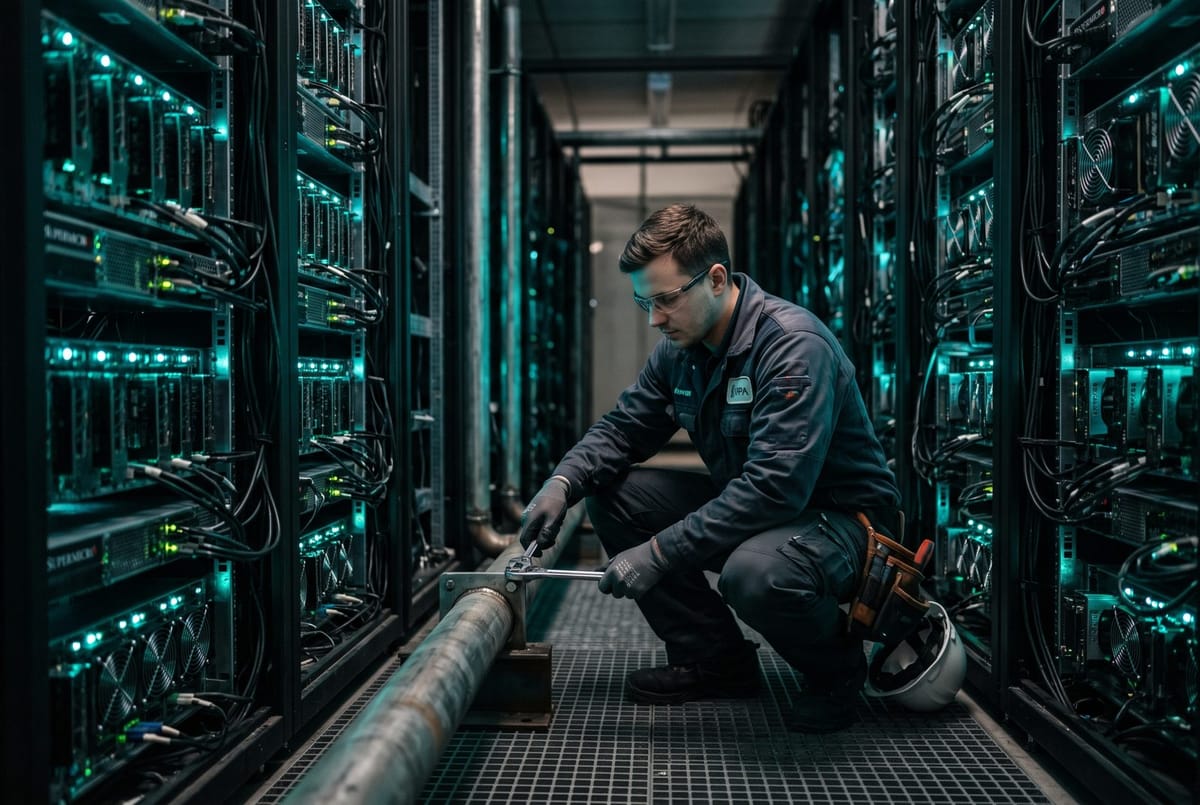
The week's money went to the least glamorous layer of the stack. Modal Labs, a New York company that rents compute to other people's AI products, closed a $750 million Series D at a $15.75 billion valuation, on a number no model lab matches: an annual revenue run rate above $1 billion. Source: Crunchbase News
The last 24 hours sharpened the pattern: Replit says it stopped renting Anthropic's models, Elorian shipped a model whose trick is looking at an image twice, DeepSeek cut cost per coding task with a checkpoint, and Black Forest Labs fit image editing onto an 8GB GPU.
The AI startups buying the boring layer
Modal Labs: $750M for the part nobody demos
Modal Labs sells serverless cloud for AI inference: you ship a Python function, Modal runs it on GPUs and bills by the second. Accel led the $750 million Series D at a $15.75 billion valuation, roughly 15x the $1 billion run rate the company says it has passed. Source: Crunchbase News
That is a services-style multiple on a business whose inputs are NVIDIA GPUs and whose prices every rival can see.
What this changes for anyone shipping today: your GPU invoice is now the revenue of a $15.75 billion company with an incentive to keep workloads on expensive hardware. The DeepSeek price war we tracked when it briefly looked like a price gap is the lever: anything you move to a smaller model or an off-peak window is margin you keep.
Elorian: a $55M seed and a model that zooms
Elorian is a Palo Alto lab founded by Andrew Dai, previously a Google DeepMind researcher. It raised a $55 million seed at a $300 million valuation before shipping anything, co-led by Striker, Menlo Ventures and Altimeter Capital, with Nvidia and Jeff Dean participating, then released Glimpse on Friday as a research preview. Source: TechCrunch
The bet is narrow. Most multimodal models turn an image into tokens once and reason in text afterwards. Glimpse keeps the image in the loop, cropping into a region, pulling video frames or running code mid-reasoning, a visual scratch space in Elorian's words. A few hundred GPUs sufficed, and the company claims it beats GPT-6 Astra on chart reasoning and video captioning on its own evaluations, at $0.60 per million input and $3 per million output tokens. Crop-and-zoom is not new, since OpenAI shipped it in 2025, so the claim is cheaper training on a model organized around the trick, and a research preview with vendor-reported evals proves direction rather than a lead.
Replit says it stopped renting Anthropic's models
Replit is a browser-based development platform where users build and deploy apps; Amjad Masad is its co-founder and CEO. At TechCrunch Disrupt on Thursday he said Replit is no longer working with Anthropic, citing cost, partnership and performance, and that internal and public benchmarks show Sol and Astra far ahead of Claude at building vibe-coded apps from scratch. Source: TechCrunch
The timeline is awkward. Replit announced an OpenAI partnership in August, and Inc reported the Anthropic relationship helped grow revenue 10x. TechCrunch then found insiders disputing the split, plus a late-September Replit post listing Claude Fable 5 and 5.1 in Agent's production environment. Enterprise, once 2% of revenue, is now about 15%, and that segment renegotiates contracts.
What this changes for anyone shipping today: treat the frontier model as a swappable component with a 90-day re-evaluation cadence, the same commodity signal as Harvey's decision to hedge with open weights. Keep an abstraction layer, keep an eval set, and never let one vendor's SDK become your architecture.
Startup Snapshot
| Startup | What They Do | Latest Round | Valuation | Why It Disrupts |
|---|---|---|---|---|
| Modal Labs | Serverless GPU compute for inference | $750M Series D (Accel) | $15.75B | Sells tokens as a utility on a $1B run rate |
| Elorian | Visual models that re-inspect images | $55M seed (Striker, Menlo, Altimeter) | $300M | Attacks the diagram gap models miss |
| Replit | Browser-based AI development | Vendor switch to OpenAI | Not disclosed | Model layer is a renegotiable input |
Viral AI: a checkpoint, a cipher and eight gigabytes of VRAM
DeepSeek's 1017 checkpoint is a Pareto play, not a launch
DeepSeek is the Chinese lab whose open-weight releases reset price expectations for coding models. V4.1 Flash launched on September 10 as a 552B-parameter mixture-of-experts model with 1M-token context under MIT-licensed weights. On October 17 it shipped DeepSeek-V4.1-Flash-1017, a checkpoint it describes as "a Pareto improvement in performance and cost." Source: DeepSeek model card
The reach is unusual for a version bump: 457 points and 240 comments on Hacker News. DeepSWE v1.1 rises from 74.2% to 77.0% and Terminal-Bench 4.0 from 31.2% to 42.3%, at a reported $0.20 per task. Read the openings as closely as the gains: DeepSeek benchmarks against Claude Opus 5's 74.0% DeepSWE, not the newer Opus 5.5, which still leads Terminal-Bench at 51.8%.
What's actually true: it is a checkpoint, not a new model. No separate parameter count or context window was published, the benchmark table is self-reported, and the headline comparison dodges the newest competitor, though anyone with an API key can verify it in an afternoon. What this changes for anyone shipping today: pin your checkpoint, because a silently improved model is also a silently changed one, and re-run your evals on every minor bump. A ¥0.3 review that found real bugs also says the cheap model should be auditing the expensive one.
Claude settled a 25-year cryptographic argument in half an hour
ECDSA is the elliptic curve cryptography standard NIST adopted in 2000 in its Digital Signature Standard. Each curve's specification publishes a seed whose hash defines a coefficient, with no explanation of how the NSA chose it. For P-256 the seed is C49D3608 86E70493 6A6678E1 139D26B7 819F7E90, and for 25 years nobody outside the agency knew where it came from. Source: Anthropic
Anthropic's Frontier Red Team says the answer took under half an hour. An employee asked an internal research model how the seeds were generated, without supplying the rumor that they hashed a joke phrase. Claude found none were hashes at all: they are output from lrand48, a C library pseudorandom generator seeded with a Unix timestamp, with P-256 needing 1,842 iterations. A scanner sliding along each seed one bit at a time across 34 generator and slice combinations found the signature, a zero top bit on every 32-bit word in four of ten seeds, a 1/5,810 coincidence. Recovering the state meant brute forcing 2^17 hidden bits for all four seeds.
What's actually true: this is not a break and not a weakness. It makes a backdoor much less plausible, since the generation method is reproducible today, and the code was released under CC0. Compare it with a 217-year-old cipher cracked by an amateur codebreaker and the pattern repeats: verification closes the case, and the work worth handing a model is the question with a mechanical answer key.
FLUX 3 Image Klein puts 4-second image generation on an 8GB GPU
Black Forest Labs is the German lab behind the FLUX image family and a standard-bearer for open-weight generative media. On October 16 it released FLUX 3 Image Klein, a 5.6B-parameter open-weights model for text-to-image, editing and multi-reference generation, with native 4K output and bounding boxes that confine an edit to a region. Source: Black Forest Labs
Weights take 11.2 GB in BF16 and 5.6 GB in FP8, and the INT8 build runs on RTX cards with as little as 8GB of VRAM through ComfyUI or Diffusers, at roughly 4 seconds per 1-megapixel image on an RTX 5090. Against FLUX.2 [klein] 9B, BFL reports a 91 Elo gain in text-to-image and 70 in editing with 38% fewer parameters, under a license allowing free commercial use below $5M revenue.
What's actually true: the weights are genuinely open and the VRAM figures are checkable, but the Elo and latency charts are BFL's own evaluations. What this changes for anyone shipping today: image editing that needed an API call now fits in a mid-range gaming laptop, eroding per-seat pricing for consumer photo tools, the same logic as DeepSeek's September open-weights release: run the high-volume share of generation locally and pay an API only for calls that need the frontier.
Viral Snapshot
| Story | What Went Viral | Engagement Signal | What's Actually True |
|---|---|---|---|
| DeepSeek V4.1 Flash 1017 | A checkpoint sold as a Pareto cost win | 457 HN points, 240 comments | Self-reported benchmarks, Opus 5.5 untested |
| Claude and the ECDSA seeds | A 25-year NSA mystery solved quickly | 961 HN points, 344 comments | Not a break; seeds came from lrand48, code is CC0 |
| FLUX 3 Image Klein | Open weights on an 8GB consumer GPU | 188 HN points, 55 comments | Elo claims are vendor-run; free use stops at $5M |
What this means for builders
Four of today's six stories are one story from four seats in the room. Modal raised $750 million at $15.75 billion to keep selling tokens, a bet on volume and utilization rather than smarter models. Replit said on a conference stage that it stopped buying a frontier model because a cheaper one benchmarked better, and its enterprise mix says the durable money sits in the workflow, not the weights. DeepSeek cut cost per coding task with a checkpoint, and Black Forest Labs fit image editing into 8GB of consumer VRAM. Intelligence keeps getting cheaper and the buyer keeps getting harder to impress, which is what a commodity looks like from the inside.
The working conclusion: stop treating model access as an asset and start treating it as a supply contract. Design so swapping models is a config change, keep an eval set that fits on one page, and spend engineering hours on the two things that do not commoditize, the workflow of record and the verification layer that decides whether an output is correct. Cheap generation can also outrun cheap verification: a review costing 30 cents is a bargain only if someone reads the bugs it finds.
Related reading
- DeepSeek's price gap and the changing economics of inference
- DeepSeek's September open-weights release and the Lovable funding round
- Harvey's open-weight pivot and the buyer-side revolt against closed models
- A 217-year-old cipher cracked by an amateur codebreaker
Frequently Asked Questions
What are the top AI startups to watch today?
The three worth tracking on October 17 are Modal Labs, Elorian and Replit. Modal raised $750 million at a $15.75 billion valuation on a $1 billion revenue run rate for inference infrastructure. Elorian shipped its first visual reasoning model after a $55 million seed, and Replit said it dropped Anthropic's models.
Why did Replit stop working with Anthropic?
Replit's CEO Amjad Masad cited cost, partnership and performance. At TechCrunch Disrupt he said internal and public benchmarks show Sol and Astra beat Claude models at building apps from scratch, though Anthropic insiders dispute that the partnership ended.
Is DeepSeek V4.1 Flash 1017 a new model?
No, it is a checkpoint update to V4.1 Flash, not a new architecture. DeepSeek calls it a Pareto improvement in performance and cost, with DeepSWE rising from 74.2% to 77.0% and Terminal-Bench 4.0 from 31.2% to 42.3%. It published no new parameter count, and the benchmarks are self-reported.
Building an AI agent, automation, or backend workflow? AsaanKaroobar builds custom AI solutions, apps, and digital experiences. Get in touch ->