Etched doubles to $21B on Jane Street's order, Unitree's record IPO, Harvey's legal AI stack, Velaura and Palona: AI Startups to Watch for August 19, 2026
AI startups to watch August 19, 2026: Etched doubles to $21B on Jane Street's order, Unitree's record IPO, Harvey's legal AI stack, Velaura and Palona.
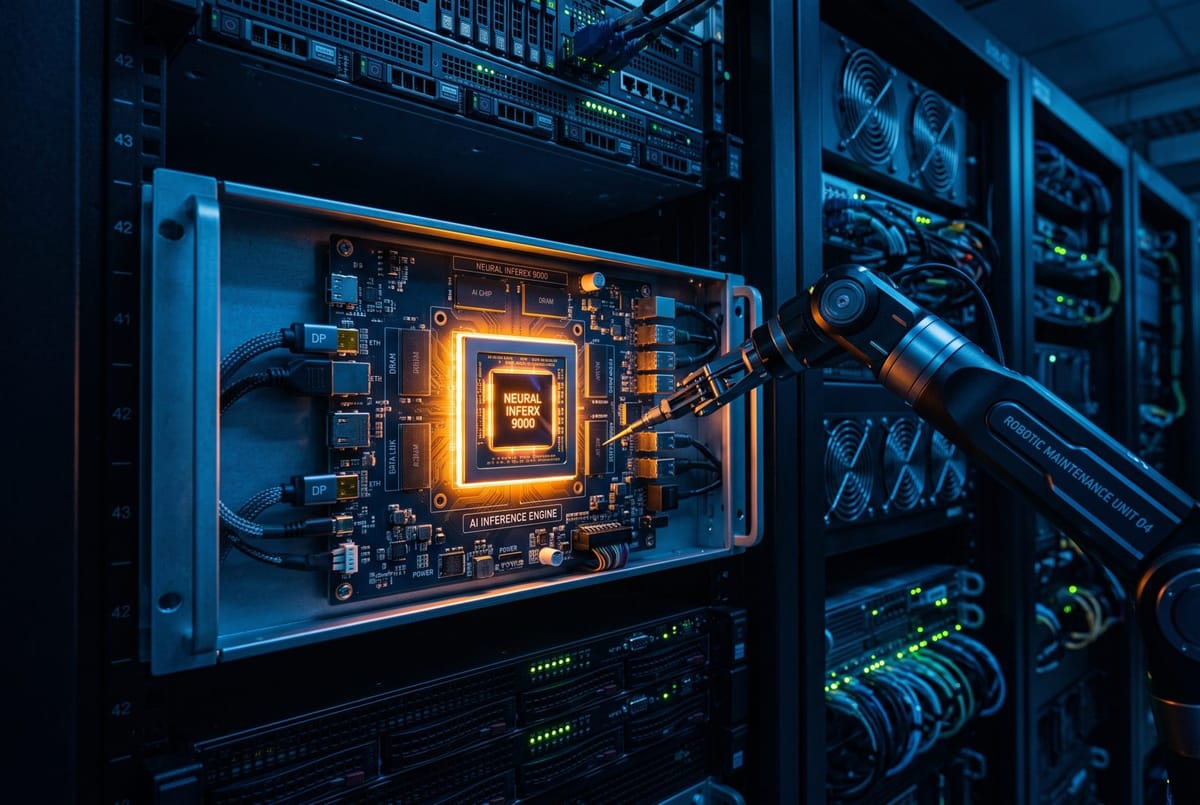
Two companies in the last 24 hours proved there is still a growth market for AI hardware, not just models: Etched doubled its valuation to $21 billion in a month, and Unitree went public in Shanghai with a record-breaking debut. Add a legal-AI platform that built its own model, a chip designer crossing $1 billion, and a startup putting AI agents in restaurants, and you have a day worth reading for anyone tracking where AI money is flowing.
Etched: $700M at $21B, after Jane Street actually used the chip
Etched raised $700 million at a $21 billion valuation, led by Jane Street, which tested the startup's transformer-specialized inference hardware and installed Etched's first shipped rack in its own data center. The valuation doubled in under a month, up from $10.3 billion in July and $5 billion in December.
TechCrunch has the technical angle: Etched designed two new components from scratch, a low-voltage prefill chip that packs in more transistors, and a "cluster-scale memory" interconnect that lets many chips share one memory pool at low latency. The pitch is higher inference speed at lower cost, and the company says it has booked more than $1 billion in contracts.
Who it hurts: Nvidia. The WSJ notes roughly 15% of Etched's approximately 400 employees came from Nvidia, and Jane Street's public endorsement gives specialist inference silicon its first marquee financial-sector customer. The old objection, that Etched etches one model into each chip, no longer applies: the systems run any frontier model.
Unitree: the humanoid-robot leader lists in Shanghai, up 600%
Unitree, the world's largest humanoid robot maker by sales, surged more than 600% on its trading debut on Shanghai's STAR market. It raised 6.1 billion yuan ($905 million) in an IPO oversubscribed more than 8,000 times, a record for the exchange. The debut makes it the first humanoid robot maker listed in mainland China.
The numbers behind the hype are real but uneven. Revenue grew more than 10x in two years to nearly 1.7 billion yuan ($252 million) in 2025, with a net profit of 278 million yuan ($41 million), and it delivered over 5,500 humanoid robots last year. On Monday it unveiled "Superman," a robot that jumps two meters and runs at 12.66 m/s. But research and education still account for most sales, industrial deployments were under 10% of revenue in early 2025, and US restrictions now bar new humanoid imports while over 40% of revenue comes from overseas.
Why now: Beijing has bet billions on humanoids as a strategic industry, and Unitree is its poster child, backed by Meituan, Tencent, Alibaba, and DeepSeek. The risk is priced in: analysts warn its edge is hardware and motion control, not embodied AI, which is why the June partnership with Nvidia matters.
Harvey: legal AI builds its own model
Harvey, the legal AI platform, introduced Harvey II, a rebuilt platform that gives legal agents persistent matter and project context plus memory of how a user works. Business Insider reports Harvey also built Tenet, its first in-house legal model, trained for legal work. The WSJ frames the memory layer as the differentiator: firms keep context across matters instead of re-explaining everything to the agent each session.
Who it threatens: every general-purpose model vendor selling to law firms, and the traditional legal-research duopoly. Owning the model plus the memory layer means Harvey controls both the intelligence and the workflow, a combination that is hard to undercut on price alone.
Velaura AI: $110M to design cheaper AI chips
Velaura AI raised $110 million in a Series A at a valuation above $1 billion, for chip-design technology aimed at cutting AI data-center power and operating costs. It joins a crowded field, but the wedge is specific: power, not raw performance, is now the binding constraint on data-center buildouts, and chip designers that attack watts per token have a clear customer story.
Palona: $20M to put AI agents in restaurants
Palona raised $20 million for a multimodal operating layer for brick-and-mortar businesses, starting with restaurants. It combines ordering agents with camera-based operations intelligence. The company says Cali BBQ's Father's Day revenue rose more than 20% year over year after deployment, and the system became the chain's most valuable catering sales channel. The disruption thesis is that labor-intensive small businesses are the next frontier for agents, not just white-collar workflows.
The Context: physical AI just raised $47.4 billion
The Unitree and Etched stories sit inside a bigger number: Crunchbase News reports physical-AI companies, spanning robotics, autonomous vehicles, drones, aerospace, and industrial automation, raised $47.4 billion across 521 deals in H1 2026, nearly four times the roughly $12 billion in the prior half-year. Waymo's $16 billion round and Anduril's $5 billion raise did much of the lifting, with Shield AI and Saronic also landing billion-dollar rounds.
The through-line across today's five startups: hardware is back. For months the money chased models and wrappers. This week it is chasing chips, robots, and physical deployments, and the valuations are scaling accordingly. Yesterday's edition tracked Groq's pivot to renting Nvidia compute; the full run of company coverage lives in our startups archive.
Related reading
Related reading from earlier coverage, with the numbers behind each one:
- AI startups raised big: Etched hit a $21B valuation, Rillet hit unicorn, Cursor launched a GitHub rival, and Navi took Prosus: AI Startups to Watch for August 20, 2026
- General Intuition Hits $6B, Lambda Eyes $3B IPO: AI Startups to Watch for August 25, 2026
- AI Startups to Watch (Sep 12): Cohere, XDOF & Kinetix
- AI Startups to Watch (Sep 8): Mistral, Instinct AI & Stoke Space