Viral AI News (Sep 20): StarCraft Flops & Psychic LLMs
Viral AI news for Sep 20, 2026: AI agents flop at StarCraft, a dev turns Jev into a lousy chatbot, and the LLMentalist effect explains why chat feels psychic.
The viral AI news this weekend was mostly about failure, and that is why it was interesting. A round-robin benchmark put the frontier models into StarCraft and watched them lose badly. A developer wrapped a model that cannot speak in a chat window and produced a very bad chatbot. An essay explaining why chatbots feel psychic kept recirculating. And underneath the jokes, one open image model quietly shipped real capability.
Frontier models get wrecked by StarCraft
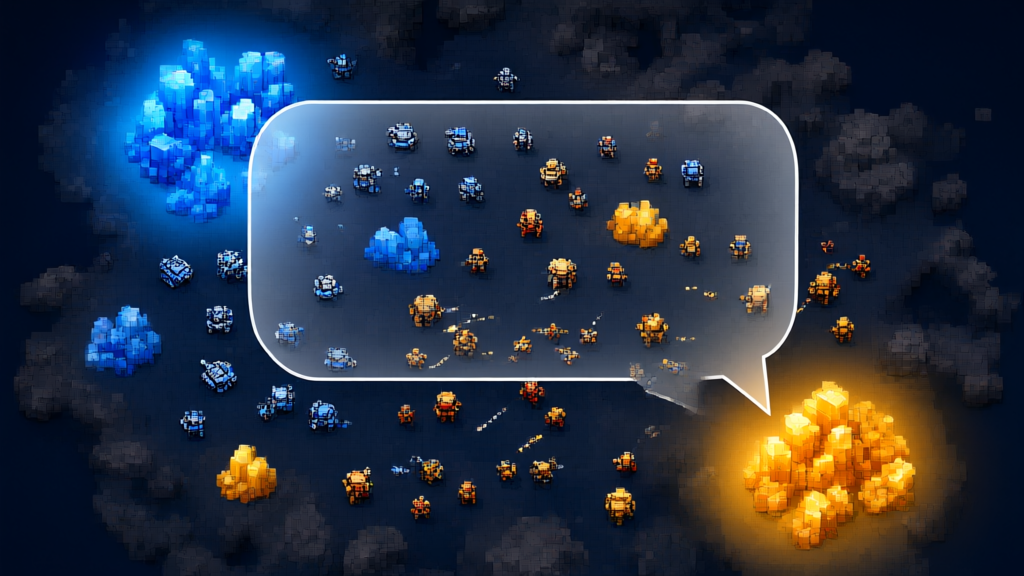
Brood War Bench is a public round-robin test that drops AI agents into StarCraft: Brood War, the 1998 real-time strategy game that is still the benchmark for machine micromanagement, and plays them against each other. The report landed on Hacker News and drew 302 points and 133 comments. Source: Brood War Bench Source: Hacker News
The results: Codex Astra at its xhigh setting won all 18 of its matches. Codex 5.6 Sol got worse as effort increased, scoring 72.2% at medium, 66.7% at low, and 61.1% at xhigh. Grok 4.6 was the story everyone shared: in one 43-minute game, its xhigh run burned 11,138 reasoning tokens, issued six command batches, and fielded zero combat units. Across the opening 15 minutes, Grok averaged 7.4 workers, two army units, and 536.6 unspent minerals, meaning it mined far more than it spent.
Astra managed 14.7 workers and 8.3 army units over the same window. Yet even the winner never played above beginner level, because older models treat a real-time game like a turn-based puzzle and spend the match thinking while the opponent expands.
Verdict: this is a real result, not a stunt, and it is the cleanest public demonstration that more reasoning is not the same as better control.
Someone turned Jev into a chatbot
Jev is the model from TypeSafe AI that does not generate text at all. It outputs type-safe decisions with calibrated probabilities, which is why its maker claims it cannot hallucinate. So a developer did the obvious spiteful thing and wrapped it in a chat interface. The result, posted as "I turned Jev into a (lousy) chatbot," hit 113 points on Hacker News. Source: GitHub
The joke is the point. Jev has no string generation to give, so a conversational wrapper produces exactly the kind of broken output you would expect from a model that answers in probabilities. Underneath the meme is a genuine shift: TypeSafe is selling decisions to software, not conversation to people, and charging $0.042 per million input tokens with free output tokens to prove it.
Verdict: worth reading as a demonstration that "better AI" and "better chat" are now different products.
Why chatbots feel psychic
The LLMentalist Effect is an essay by Baldur Bjarnason that argues chat based LLMs reproduce the mechanisms of a psychic reading rather than genuine reasoning. Cold readers rely on Barnum statements, which are vague claims that feel personal, and on subjective validation, where the listener supplies the meaning. Bjarnason argues that fluency plus sycophancy produces the same loop, and that users mistake the loop for understanding. Source: Software Crisis
Label it community-sourced analysis: this is an argument from a well-read industry critic, not a peer-reviewed finding, and there is no new experimental data in it. It recirculates because it explains a familiar feeling in unflattering terms, which is exactly the kind of essay Hacker News rewards.
Verdict: useful skepticism, but treat the framing as a hypothesis rather than a result.
Qwen-Image-2.1 ships open weights with transparency
Alibaba's Qwen team released Qwen-Image-2.1, an open weights model that handles text to image generation and image editing in one system, and it supports native transparency, something most image models fake with post processing. It arrived with companion prompt enhancer models and enough community tooling that developers started swapping it into existing pipelines on day one. Source: Hugging Face
Why it went viral: open weights plus a permissive license plus a capability that closed models usually charge for is the combination that reliably excites the local generation crowd. It got less attention than the StarCraft failures, which says something about what the timeline rewards.
Verdict: real release, real capability, under-hyped relative to its usefulness.
Quick Comparison
| Product / Trend | What Went Viral | Engagement Metric | Verdict |
| --- | --- | --- | --- |
| Brood War Bench | Frontier models lose at StarCraft | 302 points, 133 comments | Real result, unflattering |
| Jev chatbot | A non-language model in a chat UI | 113 points | The joke proves the point |
| LLMentalist Effect | Why chat feels psychic | Widely recirculated essay | Good skepticism, no data |
| Qwen-Image-2.1 | Open weights plus transparency | Day-one pipeline swaps | Under-hyped release |
Frequently Asked Questions
What is the viral AI news today?
The Brood War Bench results are the viral AI news today, because frontier models lost badly at StarCraft while burning enormous amounts of reasoning. Grok 4.6 spent 43 minutes and 11,138 reasoning tokens in one game without producing a single combat unit. Codex Astra won every match anyway. (~50 words)
Why is Jev a bad chatbot?
Jev is a bad chatbot because it cannot generate strings at all, only structured decisions with confidence scores. A developer wrapped it in a chat interface as a joke and confirmed the limitation. TypeSafe built the model for software automation, where refusing to talk is the feature. Output tokens are free because there are no words. (~52 words)
What is the LLMentalist Effect?
The LLMentalist Effect is an argument that chat models mimic cold reading instead of reasoning. Baldur Bjarnason compares their fluent, agreeable answers to Barnum statements and subjective validation, the tricks psychics use. It explains why users feel understood. The essay is opinion, not peer-reviewed evidence. (~46 words)
The Bottom Line
All three of the weekend's biggest threads were skeptical of AI capability, and two of them came from people who actually tested it. StarCraft exposed the gap between reasoning tokens and control. The LLMentalist essay explained why the gap is easy to miss in conversation. Qwen-Image-2.1 showed that open weights can still deliver something real. For yesterday's community meltdowns, see the Viral AI News post from Sep 19, and browse the Viral tag page for the archive.
---
Building an AI agent, automation, or backend workflow? AsaanKaroobar builds custom AI solutions, apps, and digital experiences. Get in touch →
Related reading
Deeper context from the archive on the companies and technologies in this story:
- Viral AI News, Sep 14: Fable 5.1 Cracks a 370-Year Cipher
- Starcloud's .3B orbital data centers, a 1B inference chip bet, and robot models that learn from a single demo: AI Startups to Watch for August 23, 2026
- General AI News (Sep 27): DeepMind Exodus, FTC & Colossus 2
- General AI News (Sep 24): Xi AI Summit, OpenAI Probe & SoftBank