AI Startups to Watch August 11, 2026
A bitcoin miner lands a .1B deal with Anthropic, a hedge fund bets 00M on dethroning ASML, and China's edge-AI startups raise big.

Six companies moved the disruption needle in the last 24 hours. A bitcoin miner signed a $9.1 billion AI compute contract. A hedge fund put $400 million into a stealth company trying to unseat ASML. Chinese startups raised big for edge models and embodied robots. Here is who is shaking things up and who gets hurt.
Riot Platforms: the miner that became an AI landlord
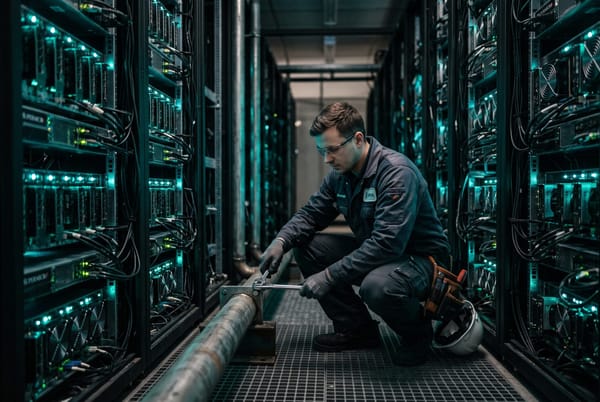
Riot Platforms, a NASDAQ-listed bitcoin miner, signed a $9.1 billion compute deal with Anthropic for 191 megawatts at its Rockdale, Texas campus, running through June 2048, with extension options that could push the total to $16.1 billion. Shares jumped about 25% after hours.
The move validates a fast-growing template: miners hold land, power contracts, and substations, and AI labs are desperate for all three. The established hyperscalers and AI clouds built their own capacity; Riot is selling theirs. Whoever sits on stranded power is now a competitor to AWS, Azure, and the dedicated AI clouds.
Source Foundry: a $400M swing at ASML
Situational Awareness, the AI-focused hedge fund run by Leopold Aschenbrenner, put another $400 million into Source Foundry at a $5 billion valuation, bringing its total commitment to about $500 million, per the WSJ and Quartz. The stealth, Stanford-founded startup wants to build the machines, tools, and software that physically manufacture AI chips, eventually taking on ASML's near-monopoly in lithography.
The disruption case is direct: ASML's ecosystem is decades of accumulated engineering and thousands of suppliers. Source Foundry is betting that AI-native design can compress that moat. It is a high-risk, high-reward swing, and $500 million from one fund is an unusually concentrated bet on a hardware company.
Discovered Materials: AI whack-a-mole for better chips
Discovered Materials, fresh out of Y Combinator, raised a $9 million seed led by Lightspeed India, with Peak XV and angels joining. The startup uses AI to screen novel semiconductor materials, hunting for substitutes that run cooler and faster than today's silicon.
This is the materials layer of the AI trade, the part most funding rounds ignore. Chip design gets the headlines; the elements and compounds chips are made from get the bottlenecks. Discovered Materials is attacking the supply chain from the chemistry up, and Lightspeed and Peak XV betting an Indian-led team can do it signals where that research is migrating.
Acorn Robot: China's zero-data bet on embodied AI
Acorn Robot, a Chinese embodied AI startup, raised a multi-hundred-million-yuan angel round co-led by China Merchants Group's venture arm and NIO Capital, per AI Market Watch. The company is pursuing a "zero-data" approach, meaning its robots learn from simulation and world models rather than massive real-world data collection, which is the expensive bottleneck every humanoid lab faces.
Who gets hurt: every embodied AI company whose moat is proprietary data collection. If zero-data training works, Tesla Optimus, Figure, and 1X lose their biggest structural advantage. NIO Capital's involvement also hints the tech is aimed at manufacturing and logistics, not just consumer robotics.
Om AI: edge models go open source in China
Om AI, the Chinese startup also known as Lianhui Technology, secured hundreds of millions of yuan from the Qianhai Fuhai Fund and open-sourced VLX-Seek 1.5, an edge-native multimodal model designed to run on phones, cameras, and industrial devices.
This is the open-source-eating-commercial-markets play. On-device AI was supposed to be a vendor-controlled market, with NPU stacks and proprietary model families. Om AI is giving the model away and monetizing deployment, a pattern that already gutted the hosted-model price floor and is now aimed at the edge.
Evoken: China's image generation platform crosses $2B
Evoken, parent of the image-generation platform LiblibAI, closed a near-$300 million Series B+ at a valuation above $2 billion, per AI Market Watch. LiblibAI is the closest thing China has to a mainstream AI image product, and the round makes it one of the country's largest AI application companies.
The disruptive angle: while Western image startups chase enterprise subscriptions, LiblibAI built a creator economy around models, prompts, and paid generations, monetizing the community itself. For Midjourney and Adobe Firefly, it is a preview of how the China market will be contested, on distribution and community rather than model quality alone.
What to watch
Two threads tie these companies together. First, the money is following power and materials: Riot's capacity, Source Foundry's lithography, Discovered Materials' chemistry. The scarcity is no longer models, it is the physical layer under them. Second, China's startups are open-sourcing aggressively (Om AI's edge model, the zero-data robot play) while US investors concentrate capital on infrastructure.
For a builder, the practical takeaway: watch Riot's contract book and Source Foundry's first tool shipments. If either delivers, the pricing power in AI moves one layer down the stack, from the models to the machines that make the machines.
Related reading
Related reading from earlier coverage, with the numbers behind each one:
- Starcloud's .3B orbital data centers, a 1B inference chip bet, and robot models that learn from a single demo: AI Startups to Watch for August 23, 2026
- DeepSeek's $74B Valuation, Perplexity's $30B Round & Nvidia's Big Bet: AI Startups to Watch for September 1, 2026
- AI Startups to Watch August 12, 2026
- General AI News August 12, 2026